

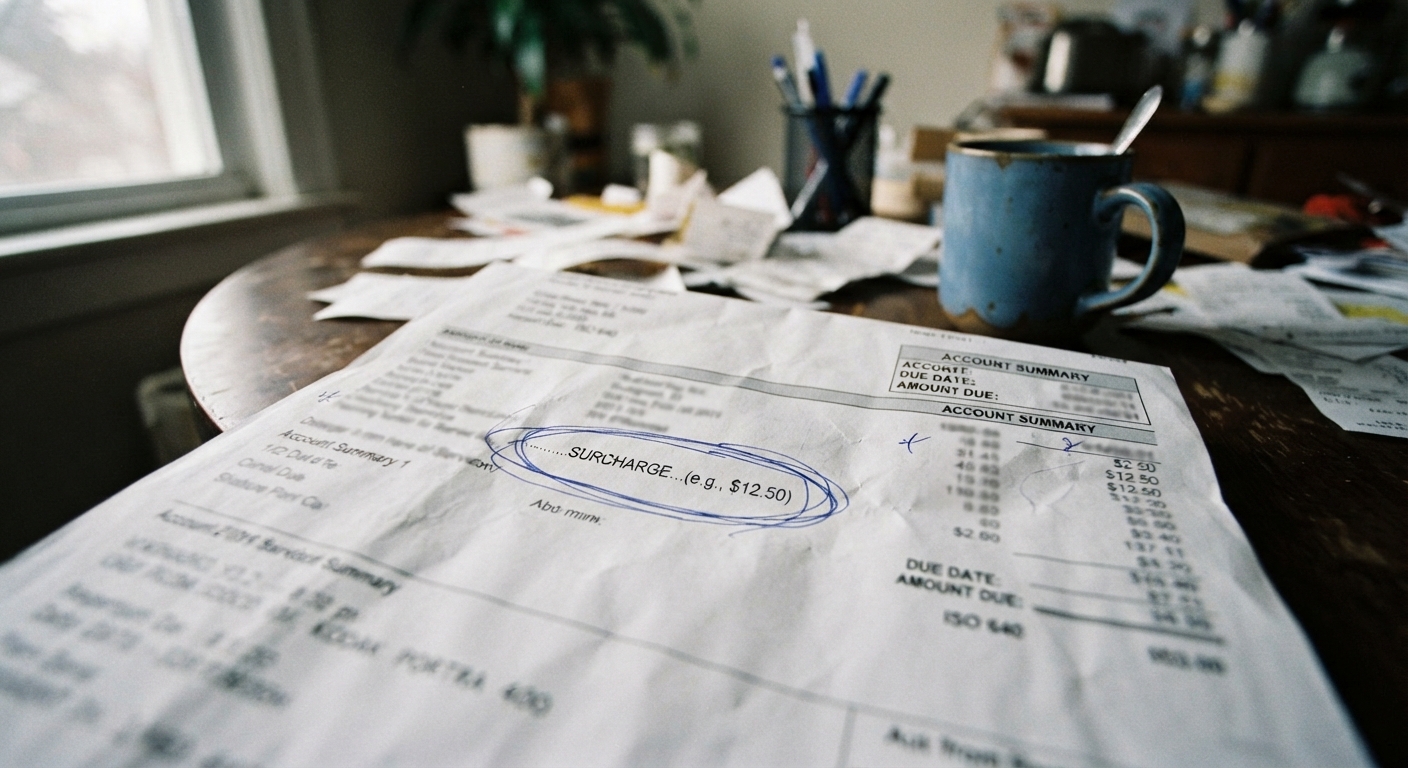
What a Pass-Through Surcharge Is and How It Differs from a Straightforward Price Increase
When a bill goes up, it’s worth pausing before you assume the company simply decided to charge more for the same service. There are really two different things that can be happening, and they look almost identical on the page even though they behave very differently underneath.
A straightforward price increase is the company raising its base rate. It costs more for the same plan, the same service, the same hours of labor, because the business decided that’s what it needs to charge now. This kind of increase is a decision, and decisions can sometimes be revisited, especially if you’re a long-time customer or you’re willing to negotiate or switch providers.
A pass-through surcharge is different. It’s a separately labeled charge that a company adds to your bill to cover a specific cost it says is outside its normal pricing, things like fuel, raw materials, electricity, or a regulatory fee imposed by a government body or industry rule. The company isn’t necessarily choosing to charge you more for its own service. It’s telling you that some outside cost went up and it’s passing that cost along, dollar for dollar or close to it, rather than absorbing it into the base price.
The practical difference is this: a base rate increase is the company’s own pricing decision, and pricing decisions are things you can push back on. A pass-through surcharge is framed as a reflection of costs the company doesn’t control, which makes it feel less like a negotiation and more like a fact of life. Whether that framing is accurate or just convenient is exactly what you want to figure out.
Common Examples: Fuel Surcharges, Energy Surcharges, and Regulatory or Compliance Fees
Once you start looking for these line items, you’ll notice they show up in more places than you’d expect.
Fuel surcharges are common with delivery services, moving companies, freight-based businesses, and some home service providers who travel to you. The idea is that when gas or diesel prices climb, the company adds a line item instead of raising its listed rate.
Energy surcharges appear on utility bills and on the bills of any business with heavy power or heating costs, like some manufacturing-adjacent services or large facilities. These are often tied to wholesale energy prices set by markets or regulators, and they can move up and down over time rather than just climbing.
Regulatory or compliance fees are a broader category and can show up almost anywhere: telecom bills, cable and internet bills, waste hauling, home security monitoring, even some subscription services with payment-processing or franchise-related fees. These are usually described as costs the company incurs to comply with a rule, license, or tax obligation, which it then spreads across its customer base as a line item rather than folding into the price you see advertised.
What ties all of these together is the label. They’re deliberately kept separate from the base price so the company can point to an outside cause when a customer asks why the total went up.
Why Surcharges Are Often Harder to Negotiate Away Than Base Rate Increases
If you’ve ever called to complain about a price hike and had good luck getting a discount, but then called about a surcharge and gotten nowhere, that’s not a coincidence.
A base rate is set by the company and can be adjusted by the company. A customer service representative often has some discretion to offer a lower rate, a promotional credit, or a loyalty discount, because the base rate is theirs to control.
A surcharge is framed as pass-through, meaning the company is telling you it’s not pocketing the difference, it’s just relaying a cost from somewhere else, a fuel market, a utility, a government fee schedule. Even if that’s true, it means the representative you’re talking to usually has no authority to waive it, because from the company’s perspective, it isn’t really their money to negotiate with. Waiving a surcharge would mean the company eating a cost it says it’s just passing along, which is a different kind of decision than a routine retention discount.
This doesn’t mean surcharges are always accurate or always fair. It means the path to challenging them is different. You’re less likely to get anywhere by asking for a discount and more likely to get somewhere by asking what the surcharge is actually tied to, how it’s calculated, and whether it changes when the underlying cost changes.
How to Find the Surcharge Explanation in Your Bill’s Fine Print or a Linked Rate Schedule
Surcharges are rarely explained in the main body of a bill. The explanation, when it exists, tends to live in a few predictable places.
Look at the very bottom of the bill or statement, where many companies put small-print definitions of each line item. Some bills list a short code or footnote number next to the surcharge that corresponds to a definition elsewhere on the page.
Check for a linked rate schedule or tariff document, especially with utilities, telecom providers, and some regulated services. These are often available on the company’s website under a name like “rates and fees,” “surcharge information,” or “regulatory fee explanation,” and they usually spell out what the surcharge is tied to and how often it’s recalculated.
Look at your bill history if you can access past statements online. If the surcharge amount has changed over time, even slightly, that’s a clue about whether it’s actually tracking an external cost (which tends to move with market prices) or whether it only ever goes up (which suggests it may function more like a rate increase with a different name).
If none of that turns up an explanation, that absence is itself useful information. A surcharge that can’t be traced to any documented formula or index is worth more scrutiny than one that’s clearly explained and tied to a published number.
Questions to Ask Customer Service to Confirm Whether a Charge Is Temporary, Tied to an Index, or Effectively Permanent
When you call, the goal isn’t to argue the charge away. It’s to get specific answers that tell you what kind of charge you’re actually dealing with. A few questions tend to get more useful answers than a general complaint:
Ask what the surcharge is officially named on the account and whether that’s the same name used in the company’s published rate documents. This helps you find the right explanation later if the representative can’t fully answer.
Ask what index, market price, or cost figure the surcharge is tied to, and how often it’s recalculated. A surcharge tied to a published fuel or energy index should be able to go down as well as up.
Ask whether the surcharge has changed in the last year and, if so, in which direction. If a representative can only point to increases, that’s worth noting.
Ask whether the surcharge is expected to end, and under what condition. “Temporary” surcharges that have no stated end date or triggering event for removal function, in practice, like permanent charges.
Ask whether the surcharge is optional in any circumstance, such as by switching to a different plan, payment method, or service tier. Sometimes surcharges are only avoidable by changing something specific about the account, and representatives don’t always volunteer that unless asked directly.
How to Decide Whether a Rising Pattern of “Temporary” Surcharges Is Really Just a Price Increase in Disguise
A single surcharge tied to a real, verifiable cost is generally exactly what it claims to be. The pattern to watch for is repetition without corresponding movement in the other direction.
If a surcharge has increased multiple times over the past couple of years but has never decreased, even during periods when the underlying cost it’s supposedly tied to (fuel prices, energy prices, a specific fee) went down, that’s a sign the “surcharge” label may be doing more marketing work than cost-tracking work.
If the company can’t produce a formula, index, or published rate schedule when asked directly, and instead describes the surcharge only in general terms like “increased costs,” that vagueness is worth weighing against the specificity you’d expect from a genuine pass-through charge.
If the surcharge has been present for years with the word “temporary” attached the entire time, with no stated end condition ever mentioned, it’s reasonable to treat it the same way you’d treat a base rate for planning purposes, even if the company doesn’t call it that.
In practice, the most useful approach is to track the surcharge amount on your bill over time, the same way you’d track a base rate. If it only moves in one direction, it’s behaving like a price increase regardless of what it’s labeled, and it’s fair to factor that into decisions about whether to keep the service, switch providers, or push back with the specific questions above rather than a general request for a discount.
