

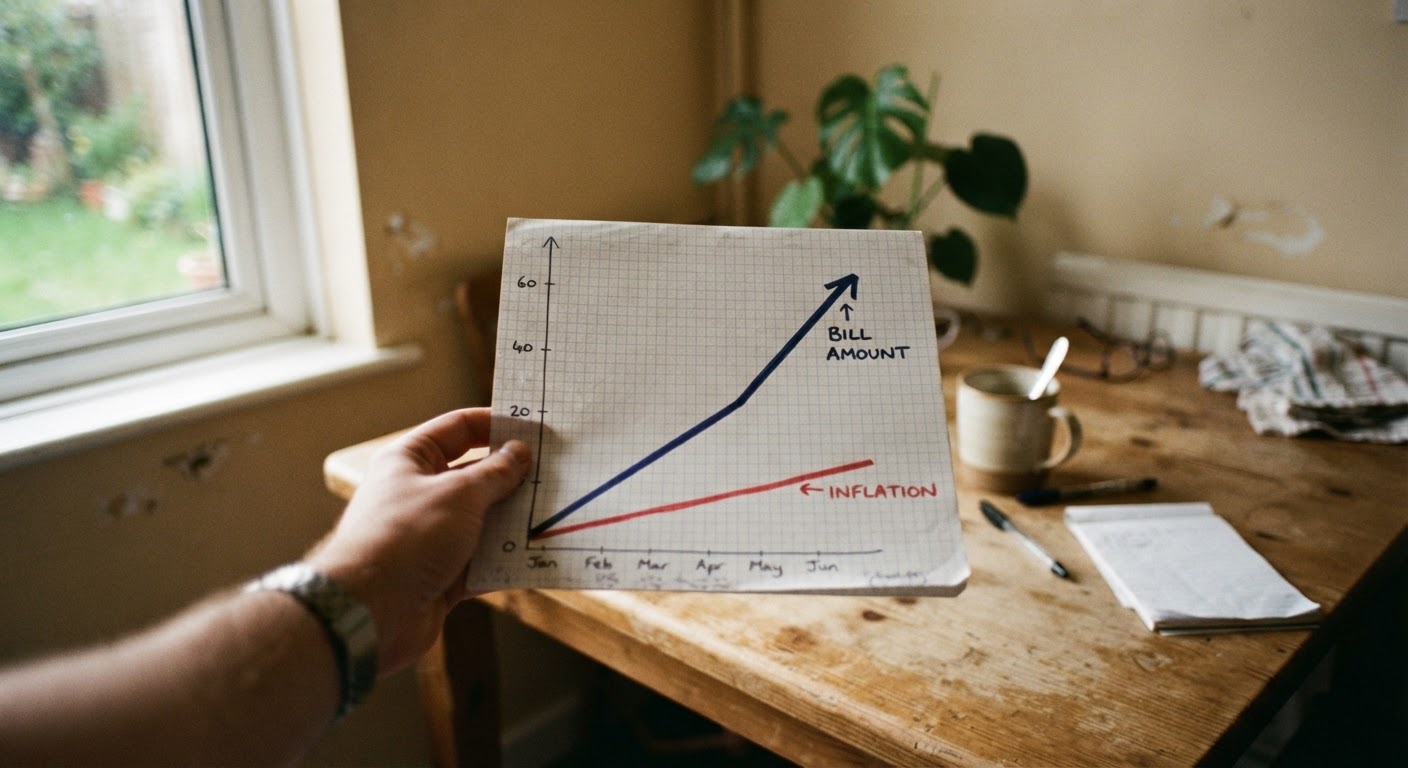
Your streaming service just raised its price again, and the email that announced it used the word “inflation” like it was an apology. Maybe it was a fair one. Or maybe your provider is using the general rise in prices as cover for an increase that has nothing to do with actual costs. The only way to know is to check the math yourself, and it takes less time than you’d think.
Where to find a reliable, current inflation benchmark
Before you can judge whether a price hike is reasonable, you need a number to measure it against. The most widely used benchmark for the cost of living in the United States is the Consumer Price Index, published by the Bureau of Labor Statistics. It tracks how much prices for a broad basket of goods and services have changed over time, and it’s updated on a regular schedule.
You don’t need to dig through a full government report to use this. The Bureau of Labor Statistics website publishes the current year-over-year percentage change in plain language, and a quick search for “current CPI inflation rate” will usually surface it from a source you can trust. Look for the headline annual rate, which is the most useful figure for comparing against a single price increase on one of your bills.
A word of caution: inflation isn’t one flat number that applies evenly to everything. The overall rate is an average across categories like housing, food, medical care, and transportation. Some categories run hotter than the average, some run cooler. If you want to be precise, some CPI reports break out subcategories, and every so often you can find one that loosely maps to your bill, such as “recreation services” for a streaming subscription. But for a household audit, the general, all-items annual rate is a solid and defensible baseline. It’s the number most companies are implicitly referencing when they invoke inflation in a price increase notice, so it’s the fairest one to hold them to.
How to calculate the percentage increase on your own bill
Once you have a benchmark, you need the actual increase on your bill, expressed the same way: as a percentage. This is simple arithmetic, but it’s worth doing carefully rather than eyeballing it.
Take your new price and subtract your old price. Divide that difference by the old price. Multiply by 100. That’s your percentage increase.
For example, if a service went from $12.99 a month to $14.99 a month, the difference is $2.00. Divide $2.00 by $12.99 and you get roughly 0.154. Multiply by 100 and that’s about a 15.4% increase. Compare that to a general inflation rate that might be sitting in the low single digits, and the gap becomes obvious.
A few practical notes on doing this well:
Use your actual billed amount, not the advertised or promotional price. If you signed up during a discount period, compare the new price to what you were actually paying the month before the increase, not to some list price you never paid.
Check whether fees, taxes, or add-ons changed too. Some providers raise the base price modestly but also add a new “service fee” or bump a regulatory surcharge, which inflates your real increase beyond what the headline number suggests. Look at the total you were charged versus the total you’re being charged now.
If the increase happened gradually across multiple statements, calculate it as one jump from your original price to your current price, not increase by increase. A string of small hikes can add up to something much larger than any single one looked.
Comparing your provider’s history of increases to inflation over the same span
A single price increase tells you something, but a pattern tells you more. If you’ve had this subscription or service for several years, pull together whatever billing history you can find, old statements, emails, your bank or card transaction history, and note the price and the date each time it changed.
Then look up the inflation rate for that same stretch of time. The Bureau of Labor Statistics publishes historical annual figures, so you can find, for instance, the cumulative change over the last three or five years rather than just the most recent twelve months. Add up your provider’s increases over that period and compare the total percentage change to the cumulative inflation figure for the same years.
This matters because a single year can be misleading in either direction. A provider might have held prices flat for a long stretch and then taken one larger jump to catch up, which can look alarming in isolation but track reasonably well over a longer window. Conversely, a provider might make it a habit to raise prices every year by a small, easy-to-miss amount that quietly outpaces inflation year after year until the gap becomes substantial.
If you don’t have detailed records going back years, even a two-point comparison, your price today versus your price two or three years ago, gives you a rough trend line that’s more informative than looking at just the latest increase.
What it means if your bill has consistently outpaced inflation
If you find that a provider’s price increases have tracked at or near the general inflation rate over time, that’s a reasonable sign the increases reflect real rising costs: labor, materials, licensing, whatever inputs go into delivering that service. It doesn’t mean you have to accept it happily, but it does mean the “inflation” explanation, if one was given, holds up.
If the increases have consistently run well above inflation, that tells you something different: the price hikes are decisions, not just pass-throughs. That could be because the service has genuinely improved and the company believes it’s worth more, because the company is trying to widen its margins, because it’s betting that the friction of cancelling is higher than the friction of just paying more, or some mix of all three. None of those reasons are necessarily unreasonable on the company’s part, but they’re also not obligations you have to quietly absorb.
This is also a useful gut check against subscription fatigue. When a bill creeps up a little at a time, it’s easy to lose track of how far it’s drifted from what you originally agreed to pay. Running the numbers turns a vague feeling of “this costs more than it used to” into a specific, defensible figure you can act on.
How to bring this comparison into a negotiation or cancellation decision
Having the numbers in hand changes the conversation, whether you’re calling to negotiate, sending a written request, or simply deciding whether to cancel.
If you’re calling to negotiate, state the comparison plainly and without hostility: your bill has gone up by a certain percentage over a certain period, general inflation over that same period was a lower percentage, and you’re asking whether there’s a lower tier, a loyalty discount, or a retention offer that brings your price back in line. Representatives are often authorized to offer something, especially for accounts that have been open a while, and a specific, calm, numbers-based request tends to land better than a general complaint about price.
If you’re deciding whether to cancel, the comparison helps you separate emotional frustration from an actual financial case. A service that’s outpaced inflation by a wide and sustained margin is a stronger candidate for cancellation or replacement with a cheaper alternative than one whose increases have simply kept pace with everything else getting more expensive. It also helps you set a threshold for the future: decide in advance how much above inflation you’re willing to tolerate before you automatically shop around, and you’ll spend less energy agonizing over each new price increase notice as it arrives.
Either way, keep the calculation somewhere you’ll find it again, a note in your phone or a line in a budgeting spreadsheet. Price increases tend to arrive quietly, one at a time, and the only real defense is a habit of checking the math before you just let the new price go through.
