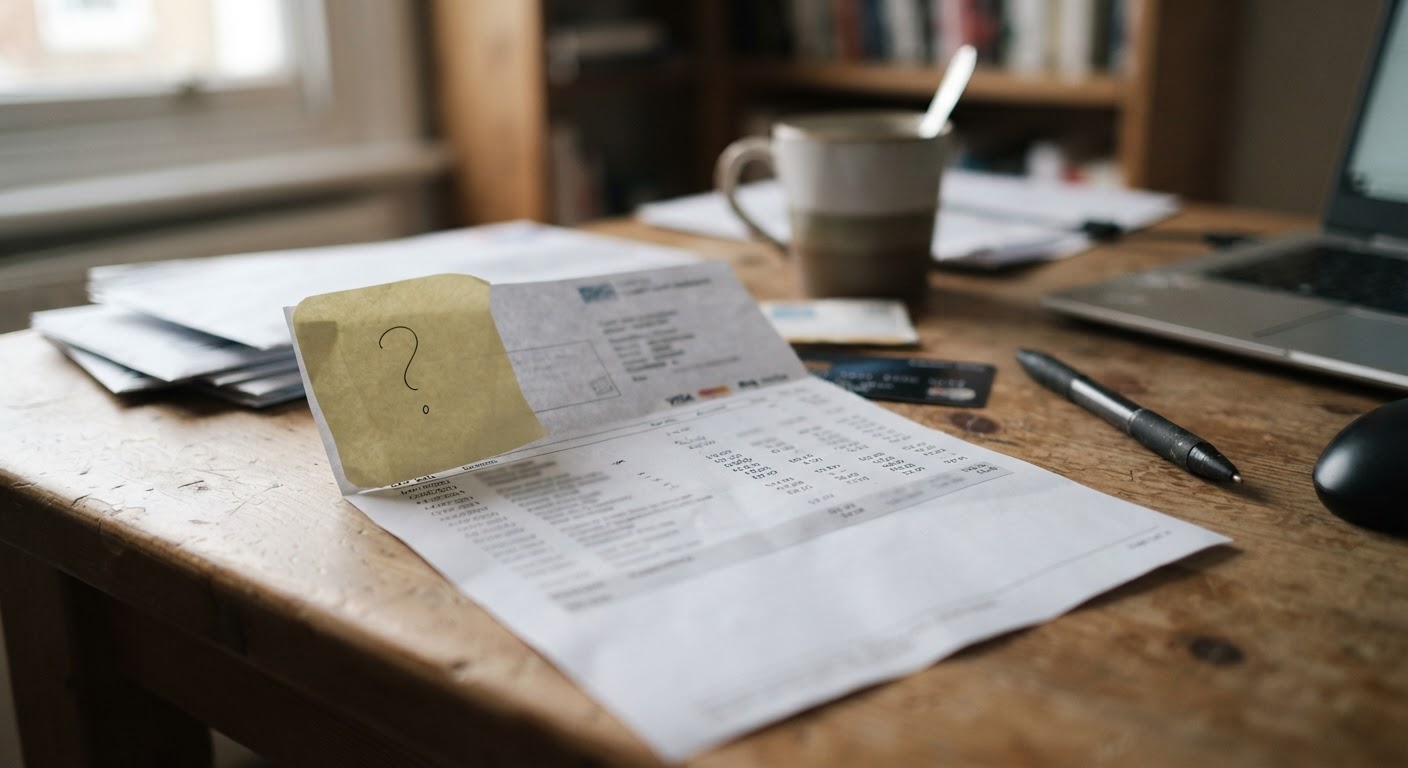
You’re scanning your statement, half paying attention, and then you stop. There’s a charge you don’t recognize. Not a huge one, but not nothing either. Your first instinct is probably somewhere between mild panic and quiet dread — is this fraud? Did I forget to cancel something? Is a family member using my card? Before you call the bank and put a freeze on everything, it helps to work through this methodically. Most mystery charges turn out to be something mundane, and there’s a logical order to figuring out which kind you’re dealing with.
Start with the amount and billing cycle, not the name
The merchant name on a statement is often the least useful piece of information you have. Payment processors frequently list a parent company, a billing agent, or a shortened version of a business name that looks nothing like what you’d search for. So instead of starting with “who is this,” start with “how much, and how often.”
Ask yourself:
- Is this a round number, or does it look like it includes tax (which suggests a real transaction rather than a recurring subscription)?
- Does the amount match anything you’re already paying for under a different name — a streaming bundle, a software suite, an app you downloaded once?
- Is this a one-time charge or does it show up as a recurring pattern? Check a few months back on the same statement or account if your bank lets you.
- What’s the billing date relative to when you might have signed up for a free trial, downloaded an app, or bought something online?
A charge that repeats on the same day every month is behaving like a subscription, even if the name means nothing to you. A charge that appears once and never again is behaving more like a purchase, a shipping fee, or a one-off service charge. This distinction matters because it changes where you look next.
If your bank or card issuer has an app, look for a transaction detail screen — many now show a “merchant category” or a small description field that didn’t make it onto your paper or PDF statement. It’s an easy thing to miss because it’s usually one extra tap, but it sometimes reveals a country, a phone number, or a category code that jogs your memory or at least narrows things down.
Searching old confirmation emails and receipts
Once you have the amount and the approximate billing pattern, go looking for a paper trail. This step feels tedious, but it resolves more mystery charges than any other single move.
Search your email for the exact dollar amount, not just a company name you’re guessing at. Try formats like “$4.99” and “4.99” separately, since search doesn’t always treat them the same. Also search for words like “receipt,” “confirmation,” “trial,” “renewal,” and “your subscription” from roughly the window before the charge first appeared.
A few other places worth checking:
- Your app store purchase history (on a phone, this is usually under your account settings, separate from your regular email) — subscriptions billed through an app store often show up on your card statement under the app store’s name, not the app’s name.
- Browser-saved passwords or autofill history, which can remind you of an account you created and forgot about.
- PayPal or similar payment account activity, if you use one, since recurring charges routed through a third-party payment service will show a different name on your bank statement than on your PayPal history.
- Text messages, since some services send a text receipt instead of, or in addition to, an email.
If you find a confirmation email, look closely at the sending domain and any account number or last-four-digits reference. It’s common to find that a $9.99 charge you didn’t recognize is a trial for a service you signed up for months ago and simply forgot, especially if it was bundled with something else you bought at the time — a “free trial included” checkbox during checkout is an easy thing to click past.
When to call the bank versus the merchant first
This is the step people tend to get backwards, usually out of understandable anxiety. Calling the bank first feels like the responsible, cautious move. But it’s not always the right first call, and it can sometimes slow down a simple fix.
Call the merchant first if:
- You’ve identified who the charge likely belongs to through your email or account search, even if you’re not sure why you’re being billed.
- The amount is small and matches a plausible subscription or trial price.
- You can log into an account associated with that company and see an active subscription or order history that matches.
In this scenario, the merchant can usually cancel the subscription, explain the charge, and in many cases refund it directly if it was a genuine mistake or an unwanted renewal — without you needing to involve your bank at all. This is almost always the faster path, and it avoids the hassle of a formal dispute process.
Call the bank or card issuer first if:
- You have no idea who the merchant is after a reasonable search, and the name on the statement doesn’t correspond to anything you can find.
- You strongly suspect your card number was compromised — for instance, multiple unfamiliar charges appeared around the same time, in different amounts, possibly in a location or currency you don’t recognize.
- You’ve already contacted the merchant and they’re unresponsive, deny the charge is theirs, or refuse to cancel or refund something that looks like an obvious mistake.
Your bank can tell you more about the transaction than what’s printed on your statement — sometimes including a phone number or location tied to the charge — and they can walk you through whether this looks like an isolated billing issue or something that warrants freezing the card. If you do call, have the exact amount, date, and any partial merchant name ready; it speeds things up considerably.
Deciding whether it’s a dispute or a forgotten trial
By this point you’ve usually landed in one of two categories, and it’s worth being honest with yourself about which one it is before you decide how to proceed.
It’s likely a forgotten trial or subscription if: you found a confirmation email or account matching the amount, the charge has a recognizable recurring pattern, and the merchant is a legitimate, known company you can actually reach through normal customer service channels. In this case, the fix is straightforward — cancel the subscription through the company’s own settings or by contacting them, ask about a refund for the most recent charge if it caught you off guard, and note the cancellation confirmation for your records in case it shows up again next month.
It’s worth treating as a potential dispute if: you cannot find any record of authorizing the charge anywhere, the merchant name doesn’t correspond to any business you can identify even after a search, the company is unreachable or refuses to explain the charge, or the charge appeared alongside other unfamiliar transactions. In that case, contact your card issuer and ask about their process for disputing a charge — most have a formal window for this, and your card’s terms or online account will spell out the current steps and any deadlines that apply.
A useful middle-ground habit: even after you resolve a mystery charge, keep a running note — a simple document or spreadsheet — of every subscription you can confirm, its billing amount, and its renewal date. The reason these charges become mysterious in the first place is almost always the same: too much time between signing up and the bill arriving, with nothing in between to jog the memory. A short list you check every few months does more to prevent this problem than any amount of after-the-fact detective work.