document.body.classList.add(‘bsp-site’);
.bsp-wrap{max-width:780px;margin:0 auto;padding:0 18px;font-family:’Segoe UI’,’Helvetica Neue’,Arial,sans-serif;color:#333;}
.bsp-wrap h2{color:#1a5276;font-size:1.4em;margin-top:28px;}
.bsp-wrap h3{color:#1a5276;font-size:1.15em;}
.bsp-wrap .intro{font-size:1.08em;color:#444;margin-bottom:14px;line-height:1.7;}
.bsp-wrap .trust-bar{background:#1a5276;color:#fff;text-align:center;padding:9px 12px;border-radius:5px;font-size:0.82em;letter-spacing:.6px;margin-bottom:22px;}
.bsp-wrap .widget-header{font-size:1.15em;font-weight:700;color:#1a5276;margin:26px 0 8px;}
.bsp-wrap .bhm-offer{min-height:460px;}
.bsp-wrap .cta-section{background:#eaf4fb;border-left:4px solid #1a5276;padding:18px;margin:30px 0 12px;border-radius:0 6px 6px 0;}
.bsp-wrap .disclosure{font-size:0.77em;color:#aaa;margin-top:30px;border-top:1px solid #eee;padding-top:12px;}
@media(max-width:768px){.bsp-wrap .bhm-offer{min-height:400px;}}
Grocery spending responds almost immediately to changed behavior. There is no contract to break, no waiting period, no negotiation required. The habits in this guide can reduce the typical household grocery bill by 20 to 35 percent within a month of consistent application.
Groceries Are the Most Controllable Major Expense
The key insight is that grocery savings are not primarily about coupons or special deals. They come from structural changes in how you shop: what you buy, when you buy it, and whether you buy it with a plan.
The List Is Non-Negotiable
Shopping without a list is the single most expensive grocery habit. Without a list, you are subject to every in-store marketing tactic designed by professionals whose full-time job is to increase your basket size. Studies consistently show that shoppers without lists spend 20 to 40 percent more per trip than list-shoppers buying for equivalent meals.
An effective grocery list is built from a meal plan, not the other way around. Decide what you will eat this week, write down exactly what ingredients you need, and buy only those things.
Store Brands: The 20 Percent Rule
Store brands are typically 20 to 30 percent cheaper than name brands for identical or near-identical products. The quality gap that existed 20 years ago has largely closed — most store-brand products are made by the same manufacturers as name brands, often on the same production lines. Switch to store brands for all commodity items: flour, sugar, salt, canned goods, frozen vegetables, pasta, cooking oil, dairy, butter, and eggs. Keep name brands only for items where you have genuinely noticed a quality difference. For a typical household, this approach reduces the grocery bill by $40 to $80 per month.
Timing Your Shopping
Grocery stores mark down perishables — bread, meat, prepared foods — when they are approaching their sell-by date, typically in the morning. Shopping on weekday mornings gives you access to these markdowns. Meat nearing its sell-by date can be purchased and frozen immediately, extending its life by weeks at 30 to 50 percent off regular price. Shopping on a full stomach reduces impulse purchases significantly — this is well documented in consumer behavior research.
Using Loyalty Apps and Digital Coupons
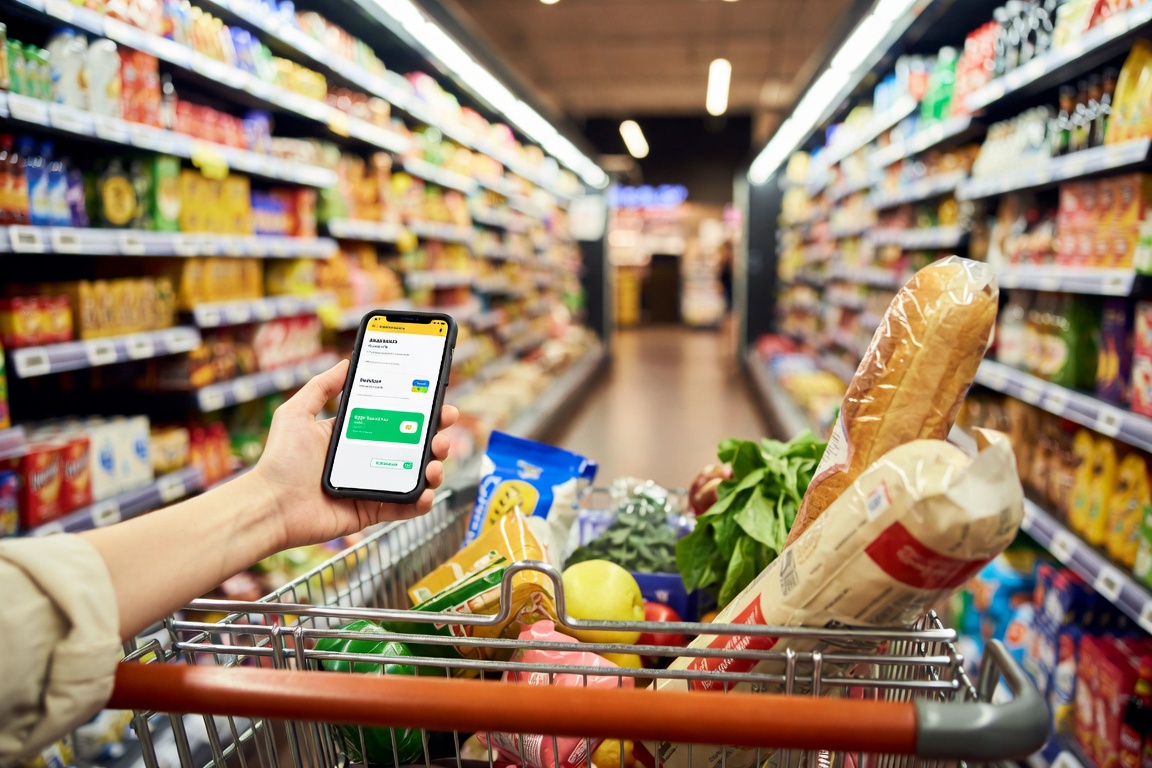
Every major grocery chain now has a digital loyalty app that offers personalized deals and digital coupons. Clipping these before each trip takes about two minutes and can yield $5 to $15 in savings per trip on items you would buy anyway. Cashback apps like Ibotta offer additional rebates on specific grocery items, redeemable as cash. Combining store loyalty discounts with Ibotta cashback and paying with a cash-back credit card creates a stacking system that realistically delivers $15 to $30 per week in combined savings on a typical grocery run.
Buying in Bulk — Intelligently
Bulk buying saves money only when applied to items you will definitely use before they expire or become stale. The right candidates: non-perishable pantry staples (rice, pasta, canned goods, dried beans), household consumables (paper products, cleaning supplies, personal care), and freezer-stable proteins. Before each bulk purchase, calculate the cost per unit and compare to the regular store price. A bulk deal that is actually more expensive per unit than the standard shelf price is surprisingly common in club stores.
Reducing Food Waste
The USDA estimates that the average American household wastes about 31 percent of the food they purchase — roughly $1,500 per year for a family of four. Reducing food waste is equivalent to a substantial grocery discount. The most effective tactics: first-in-first-out organization in the fridge and pantry, using older ingredients first in meal planning, and repurposing food that is past peak but not spoiled — vegetable scraps for broth, slightly stale bread for croutons. A household that cuts food waste by half effectively gives themselves a 15 percent grocery discount for free.
Disclosure: This site may receive compensation when you click on links or complete offers through our partners. Content is for informational purposes only and does not constitute financial advice.