

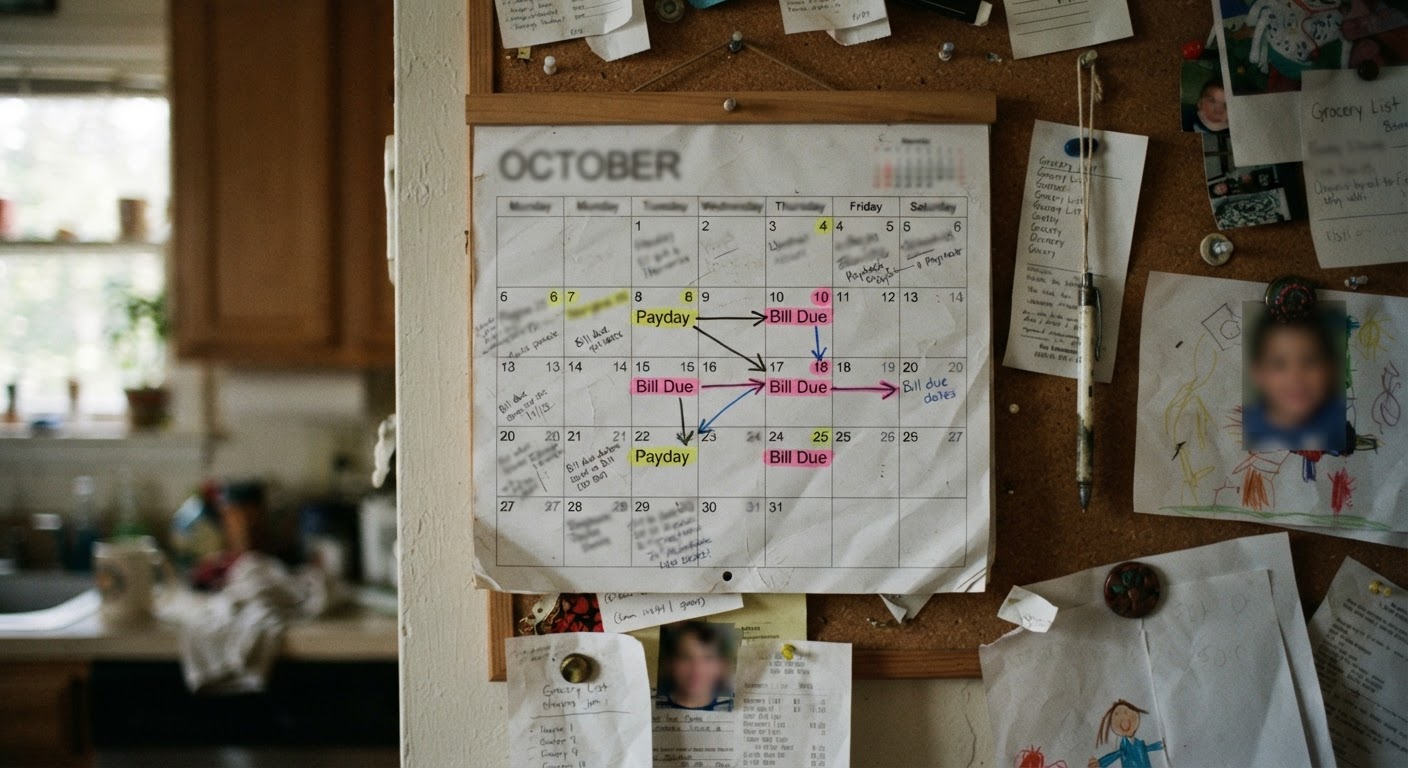
Most budgeting advice tells you to line up your bills by due date and check them off as they come. That works fine until the day arrives, the money isn’t there yet, and you’re staring at a due date that doesn’t care that payday is three days away. Due dates only tell you the last moment a payment is acceptable. They say nothing about whether you’ll have the cash on hand when that moment arrives. That’s a cash flow problem, not a scheduling problem, and it needs a different tool than a simple list of dates.
A bill payment calendar built around your paycheck schedule solves this by working backward. Instead of asking “when is this due,” you ask “which paycheck is going to cover this,” and you plan the payment for shortly after that paycheck lands, not right before the due date. The due date becomes a deadline you beat comfortably, not a deadline you’re racing.
This matters more than it sounds like it should, because a lot of household budgeting stress isn’t actually about not having enough money over the course of a month. It’s about the money arriving in the wrong order relative to when it’s needed. You can be perfectly solvent on a monthly basis and still overdraft your account twice a year because three bills landed in the same week your paycheck was running late or thin.
The difference between biweekly, semimonthly, and weekly pay cycles and why it matters
Before you can map bills to paychecks, you need to be precise about how your pay actually cycles, because the three common schedules behave very differently over the course of a year.
A weekly pay schedule gives you a paycheck every seven days, which usually works out to 52 paychecks a year. A biweekly schedule pays every two weeks, landing you 26 paychecks a year. A semimonthly schedule pays twice a month, typically on fixed dates like the 15th and the last day of the month, giving you 24 paychecks a year.
The reason this distinction matters is that biweekly and semimonthly look similar on paper but behave differently in practice. With biweekly pay, because 26 paychecks don’t divide evenly into 12 months, there are two months a year where you get three paychecks instead of two. Those extra-paycheck months feel like a windfall, but the flip side is that in the other months, the gap between paychecks can stretch in a way that doesn’t line up neatly with the first-of-the-month bills most billers default to.
Semimonthly pay avoids that three-paycheck-month quirk since you always get exactly two paychecks a month, but those two paychecks land on fixed dates rather than fixed intervals, so the gap between them varies. The gap from a 15th paycheck to an end-of-month paycheck is shorter than the gap from an end-of-month paycheck to the following 15th.
Weekly pay has the smoothest cash flow of the three because money arrives so frequently, but it also means you’re doing this mapping exercise four or five times a month instead of two, so the calendar needs to be simpler, not more detailed, to actually get used.
The point of understanding your specific cycle isn’t trivia. It’s that the calendar you build has to match the actual rhythm of money coming in, not a generic monthly grid.
How to map each recurring bill to the paycheck that will cover it
Once you know your pay cycle, the mapping process is straightforward, even if it takes a bit of time to do once.
Start by listing every recurring bill you have, along with its due date and amount: rent or mortgage, utilities, phone, insurance premiums, subscriptions, loan payments, anything that repeats monthly or more often. Then lay out your paycheck dates for a full month or two, since that’s usually enough to reveal the pattern that repeats going forward.
For each bill, ask a simple question: which paycheck, if I set money aside from it, would cover this bill with room to spare before the due date? Assign that bill to that paycheck. Not the paycheck that arrives right before the due date if that’s cutting it close, but the paycheck that gives you a buffer of several days at minimum.
As you do this for every bill, you’ll start to see paychecks that are carrying a heavy load and paychecks that are relatively light. That’s useful information on its own. If one paycheck is covering rent, a car payment, and an insurance premium while the other paycheck mostly just covers groceries and gas, you’ve found the paycheck that needs the most protection from other spending.
It also helps to total up each paycheck’s assigned bills and compare that total to the paycheck amount. If a single paycheck’s bills come close to or exceed that paycheck’s take-home amount, that’s a structural problem worth addressing, either by moving some bills to the other paycheck through a due date change, or by building a larger buffer so that paycheck’s shortfall gets covered by savings rather than by the next paycheck arriving late in the game.
Handling bills that fall in the ‘gap’ between paychecks
No matter how carefully you map bills to paychecks, you’ll run into at least one that falls into what’s often called the gap: a due date that lands in the stretch of days after one paycheck has been mostly spent but before the next one arrives.
The most direct fix is a small dedicated buffer, sometimes called a bill smoothing fund, that exists separately from your regular checking balance. The idea is that instead of trying to time every bill perfectly against every paycheck, you keep a cushion equal to one or two of your gap bills sitting in an account you don’t touch for everyday spending. When a gap bill comes due, it draws from that buffer instead of from whatever’s left in checking. Then, on the next paycheck, you replenish the buffer before spending on anything discretionary.
This takes some pressure off the mapping exercise, because you’re not relying on split-second timing to make every bill land correctly. The buffer absorbs the mismatch.
If building a buffer isn’t realistic right away, the next best option is identifying which gap bills have some flexibility in their due date, since many billers, especially utilities and subscription services, will move a due date on request. That flexibility is the subject of the next section, but it’s worth knowing that gap bills are usually the first ones you should target for a due date change, since they’re the ones causing the actual friction.
Adjusting due dates with billers to match your pay schedule when possible
Many recurring billers, particularly utilities, phone carriers, streaming and subscription services, and some loan servicers, will let you request a different due date, sometimes right through their website or app, sometimes by calling customer service and asking directly. It’s a simple request, and being asked for it is routine for most billing departments.
The general approach is to figure out, based on the mapping you did earlier, what due date would sit comfortably after your paycheck rather than awkwardly in the gap before it, and then request that date. If you’re paid biweekly on Fridays, for instance, a due date on the 3rd of the month might be painful if your paycheck doesn’t land until the 5th, but a due date moved to the 10th could line up cleanly.
Not every biller will accommodate this, and some may have limits on how often you can change it once it’s set, so it’s worth making the change deliberately rather than repeatedly. It also helps to make these changes one at a time rather than all at once, so you can see the effect on your calendar clearly before moving on to the next bill.
Over time, the goal is a calendar where due dates cluster shortly after paychecks rather than scattered randomly across the month. You won’t be able to align every single bill this way, and that’s fine. Even shifting two or three of your most troublesome bills can turn a month that used to feel like a scramble into one that runs on autopilot.
