document.body.classList.add(‘bsp-site’);
.bsp-wrap{max-width:780px;margin:0 auto;padding:0 18px;font-family:’Segoe UI’,’Helvetica Neue’,Arial,sans-serif;color:#333;}
.bsp-wrap h2{color:#1a5276;font-size:1.4em;margin-top:28px;}
.bsp-wrap h3{color:#1a5276;font-size:1.15em;}
.bsp-wrap .intro{font-size:1.08em;color:#444;margin-bottom:14px;line-height:1.7;}
.bsp-wrap .trust-bar{background:#1a5276;color:#fff;text-align:center;padding:9px 12px;border-radius:5px;font-size:0.82em;letter-spacing:.6px;margin-bottom:22px;}
.bsp-wrap .widget-header{font-size:1.15em;font-weight:700;color:#1a5276;margin:26px 0 8px;}
.bsp-wrap .bhm-offer{min-height:460px;}
.bsp-wrap .cta-section{background:#eaf4fb;border-left:4px solid #1a5276;padding:18px;margin:30px 0 12px;border-radius:0 6px 6px 0;}
.bsp-wrap .disclosure{font-size:0.77em;color:#aaa;margin-top:30px;border-top:1px solid #eee;padding-top:12px;}
@media(max-width:768px){.bsp-wrap .bhm-offer{min-height:400px;}}
Most people pay their electricity bill without knowing which appliances or behaviors drive their costs. Understanding your actual energy usage is the foundation for targeted reductions — and in most cases, a few specific changes produce the majority of the savings.
Why Understanding Matters Before Acting
Energy-saving advice is abundant. Suggestions to turn off lights, unplug chargers, and run the dishwasher at night are everywhere. The problem is that these actions, while worthwhile, are not equal in impact. Turning off a single incandescent light bulb saves a fraction of what adjusting your water heater temperature saves. Focusing your effort on the highest-impact changes requires understanding where your energy actually goes.
How to Read Your Energy Bill
Your electric bill tells you how many kilowatt-hours (kWh) you used in the billing period. Compare this number to the same period last year to identify trends. If your usage is increasing year over year without adding new appliances or household members, something has changed — an aging appliance running less efficiently, an HVAC system working harder, a new behavior pattern. The trend line is more informative than any single month’s bill.
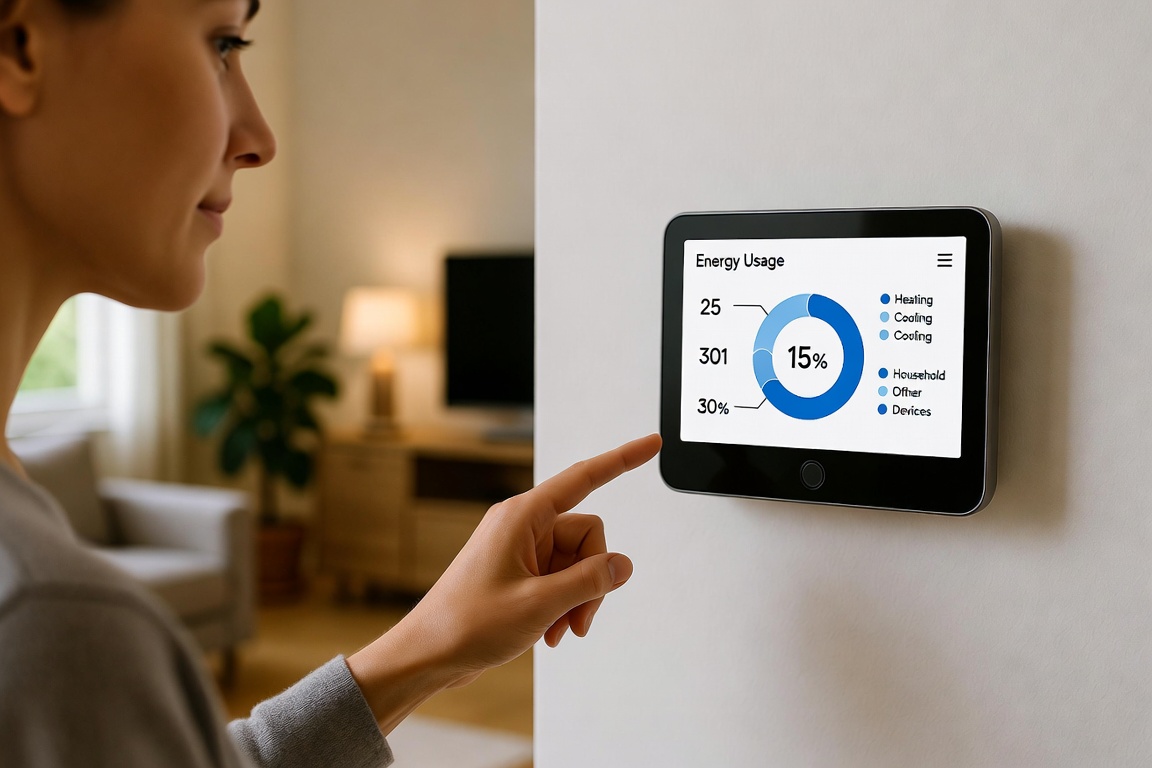
Your utility’s online account typically provides a usage graph by day or hour. This more granular view reveals specific patterns — a spike every evening at 6 PM when the electric oven is running, elevated overnight usage suggesting a malfunctioning appliance, or a usage floor that never drops below a certain level even at 3 AM (indicating significant phantom load).
The Big Three Energy Users
In most American homes, three categories account for 50 to 70 percent of total electricity consumption: heating and cooling (the HVAC system), the water heater, and major appliances (refrigerator, washer, dryer, oven). These three categories deserve the most attention because even small efficiency improvements in them have more financial impact than dramatic improvements in lower-consumption categories.
HVAC: Each degree of thermostat adjustment in the right direction saves approximately 1 to 3 percent on HVAC costs. A programmable thermostat that adjusts 8 degrees during sleep and away hours can cut HVAC costs by 10 to 15 percent annually. System maintenance — clean filters, sealed ducts, adequate refrigerant — ensures the equipment operates at rated efficiency.
Water heater: Most water heaters are set at 140 degrees Fahrenheit from the factory. Reducing to 120 degrees cuts water heating energy use by 4 to 22 percent with no practical impact on daily use. Insulating the tank and the first three feet of hot water pipe further reduces standby heat loss.
Refrigerator: The refrigerator runs continuously and accounts for 5 to 10 percent of the average home’s electricity use. Keep it at 37 to 40 degrees Fahrenheit (not colder), clean the condenser coils twice per year, and ensure the door seals are tight. An older, inefficient refrigerator can use two to three times the electricity of a modern ENERGY STAR model — if yours is more than 15 years old, a replacement may pay for itself within a few years.
Phantom Load: The Silent Drain
Phantom load — electricity consumed by devices in standby mode — accounts for 5 to 10 percent of the average home’s electricity bill. The biggest offenders are televisions, gaming consoles, cable boxes, desktop computers, and chargers. Smart power strips that cut power to devices when not in use eliminate phantom load automatically. For high-use areas like the entertainment center, a single smart strip can save $10 to $30 per year.
Measuring Your Own Usage
A plug-in energy monitor (available for $15 to $30) allows you to measure the exact power consumption of any device in your home. Plugging each major appliance in for 24 hours reveals the actual daily electricity cost of that device. This data often produces surprises — an old dehumidifier or space heater running for hours per day may be costing far more than expected. With concrete numbers, you can make data-driven decisions about which devices to replace, which to use less, and which turn out to be negligible contributors to your bill.
Disclosure: This site may receive compensation when you click on links or complete offers through our partners. Content is for informational purposes only and does not constitute financial advice.