document.body.classList.add(‘bsp-site’);
.bsp-wrap{max-width:780px;margin:0 auto;padding:0 18px;font-family:’Segoe UI’,’Helvetica Neue’,Arial,sans-serif;color:#333;}
.bsp-wrap h2{color:#1a5276;font-size:1.4em;margin-top:28px;}
.bsp-wrap h3{color:#1a5276;font-size:1.15em;}
.bsp-wrap .intro{font-size:1.08em;color:#444;margin-bottom:14px;line-height:1.7;}
.bsp-wrap .trust-bar{background:#1a5276;color:#fff;text-align:center;padding:9px 12px;border-radius:5px;font-size:0.82em;letter-spacing:.6px;margin-bottom:22px;}
.bsp-wrap .widget-header{font-size:1.15em;font-weight:700;color:#1a5276;margin:26px 0 8px;}
.bsp-wrap .bhm-offer{min-height:460px;}
.bsp-wrap .cta-section{background:#eaf4fb;border-left:4px solid #1a5276;padding:18px;margin:30px 0 12px;border-radius:0 6px 6px 0;}
.bsp-wrap .disclosure{font-size:0.77em;color:#aaa;margin-top:30px;border-top:1px solid #eee;padding-top:12px;}
@media(max-width:768px){.bsp-wrap .bhm-offer{min-height:400px;}}
Seasonal bill spikes — the summer electric bill, the winter heating bill, the holiday spending surge — arrive on a completely predictable schedule yet catch most households off guard financially. The preparation strategies here convert these predictable spikes into planned, manageable expenses.
Predictable Does Not Mean Automatic
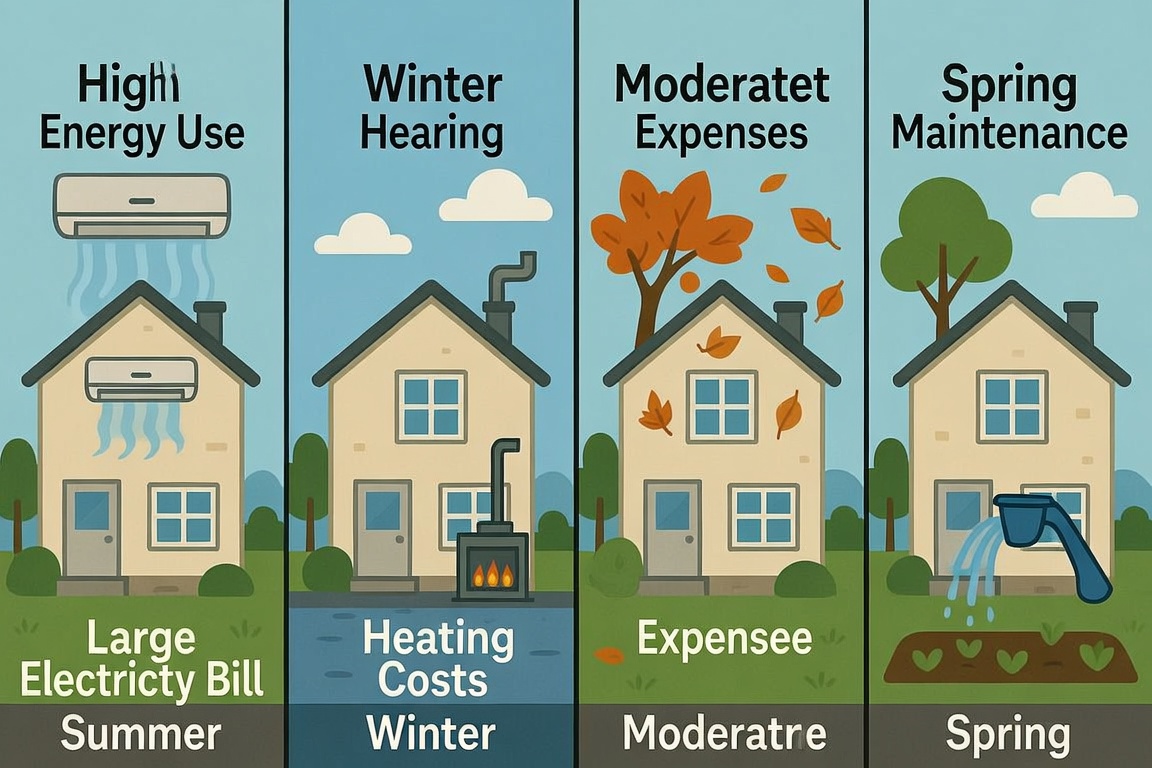
The seasonal pattern of household expenses is remarkably consistent year to year. Summer electricity bills spike due to air conditioning. Winter heating bills climb dramatically in cold climates. November and December compress holiday spending into a six-week window. August front-loads back-to-school expenses. Travel costs peak in June through August and again around major holidays.
What makes these spikes financially damaging is not unpredictability — it is the gap between knowing they are coming and actually being financially prepared when they arrive. Closing that gap requires planning that begins months before the spike, not the week it arrives.
Summer Cooling Costs
Cooling costs typically represent the largest single seasonal utility spike for most U.S. households. In warmer climates, June through September electric bills can run 40 to 80 percent higher than shoulder-season months. Preparing for this spike involves both financial preparation and efficiency preparation.
On the efficiency side: schedule an HVAC tune-up before cooling season begins (April or early May). A well-maintained system runs significantly more efficiently than a neglected one — the cost of a tune-up is typically recovered in the first month of operation through improved efficiency. Seal any air leaks that appeared or worsened over winter. Check that ceiling fans are set to counterclockwise rotation for summer (this creates a wind-chill effect, allowing you to set the thermostat 4 degrees higher with the same comfort level).
On the financial side: start setting aside a cooling reserve in March. If your summer electric bill runs $80 higher per month than your spring bill, set aside $80 extra per month starting in March so that when June’s bill arrives, the money is already there.
Winter Heating Costs
Winter preparation should begin in September for cold-climate households. Weatherizing the home — fresh weatherstripping, draft-proofing around outlets and switches, checking attic insulation — can reduce heating costs by 15 to 25 percent for the season. A furnace or boiler tune-up in September ensures the system is running at peak efficiency when it matters most.
Many utilities offer a “budget billing” or “average billing” option that spreads your annual energy costs evenly across 12 months, eliminating seasonal spikes entirely. This is particularly valuable for households on fixed or irregular income. Contact your utility to enroll before winter heating season begins.
Holiday Spending: Plan in January
The most effective holiday spending strategy is one that begins in January. Set a total holiday budget for the year — including gifts, travel, entertaining, and decorations. Divide by 12 and save that amount monthly in a designated account. By November, the money is fully funded and holiday spending becomes a choice rather than a financial emergency.
Households that plan holiday spending this way spend approximately 30 percent less than those who fund holiday expenses reactively. The combination of advance planning, price monitoring through the year, and freedom from financial stress produces better decisions and lower total costs.
Back-to-School Season
For families with school-age children, August school shopping can represent $200 to $800 in concentrated spending. Build this into the sinking fund approach described in other articles — setting aside $20 to $65 per month year-round so that August shopping is fully funded in advance.
Additionally, many school districts publish supply lists in the spring. Purchasing supplies in May and June, when retailers are not yet selling at back-to-school premium prices, can save 15 to 20 percent on the same items. This is a simple advance-planning strategy that saves money with essentially no additional effort.
Travel Season
Summer and holiday travel are among the most price-elastic seasonal expenses — prices for flights, hotels, and rental cars vary by 50 to 100 percent between peak and off-peak booking. Planning travel six months in advance and choosing to travel on the shoulder of peak season (mid-May rather than July 4th week, early December rather than the week before Christmas) can cut travel costs by 30 to 50 percent for comparable trips.
Disclosure: This site may receive compensation when you click on links or complete offers through our partners. Content is for informational purposes only and does not constitute financial advice.