document.body.classList.add(‘bsp-site’);
.bsp-wrap{max-width:780px;margin:0 auto;padding:0 18px;font-family:’Segoe UI’,’Helvetica Neue’,Arial,sans-serif;color:#333;}
.bsp-wrap h2{color:#1a5276;font-size:1.4em;margin-top:28px;}
.bsp-wrap h3{color:#1a5276;font-size:1.15em;}
.bsp-wrap .intro{font-size:1.08em;color:#444;margin-bottom:14px;line-height:1.7;}
.bsp-wrap .trust-bar{background:#1a5276;color:#fff;text-align:center;padding:9px 12px;border-radius:5px;font-size:0.82em;letter-spacing:.6px;margin-bottom:22px;}
.bsp-wrap .widget-header{font-size:1.15em;font-weight:700;color:#1a5276;margin:26px 0 8px;}
.bsp-wrap .bhm-offer{min-height:460px;}
.bsp-wrap .cta-section{background:#eaf4fb;border-left:4px solid #1a5276;padding:18px;margin:30px 0 12px;border-radius:0 6px 6px 0;}
.bsp-wrap .disclosure{font-size:0.77em;color:#aaa;margin-top:30px;border-top:1px solid #eee;padding-top:12px;}
@media(max-width:768px){.bsp-wrap .bhm-offer{min-height:400px;}}
Car registration, annual insurance premiums, holiday spending, property taxes, home maintenance — these bills come every year, but most households still treat them as surprises. Planning for irregular expenses is one of the highest-leverage habits in personal finance.
Irregular Bills Are the Budget Killer Most People Overlook
Monthly budget breakdowns are familiar territory for most households. Housing, food, utilities, transportation — these categories are easy to track because they recur every 30 days. The category that consistently breaks budgets is not any of these. It is the irregular, predictable-but-forgotten expense that arrives without adequate preparation.
The good news is that virtually every irregular expense is foreseeable. Vehicle registration renews on the same date every year. Property taxes are assessed on a known schedule. Insurance renewals are communicated months in advance. The problem is not that these expenses are unpredictable — it is that most household budgets are built around monthly recurring costs and do not account for the irregular ones.
The Complete Irregular Expense Inventory
The first step is documenting every non-monthly expense you expect in the coming 12 months. Common categories include: vehicle registration and inspection fees, annual insurance premium payments (if not monthly), property taxes (if not escrowed), estimated tax payments for self-employed households, holiday and gift spending, annual subscriptions billed annually, home maintenance reserves, vehicle maintenance (oil changes, tires, inspections), medical deductibles and out-of-pocket costs, and school-related expenses.
For each item, note the expected month and the expected cost. Use last year’s actual figures as your baseline. Add a 10 percent buffer to any estimate that tends to run over.
The Sinking Fund Method
Once you have your total annual irregular expenses, divide by 12. The result is the monthly amount you need to set aside to cover them without stress. This technique — sometimes called a sinking fund — transforms unpredictable annual expenses into predictable monthly ones.
For example: if your total irregular expenses for the year are $3,600, you need to set aside $300 per month. Open a separate savings account designated specifically for these funds — keeping them separate from your regular operating account prevents the money from being spent on daily expenses. Many online banks allow you to name savings buckets, making this even more organized.
The Home Maintenance Reserve
Home repairs are one of the most financially disruptive irregular expenses for homeowners. Financial planning guidelines typically recommend setting aside 1 to 2 percent of your home’s value per year for maintenance and repairs. For a $250,000 home, that is $2,500 to $5,000 per year — $208 to $416 per month into a dedicated reserve.
This reserve is not a prediction that you will spend that amount every year. Some years will be higher, some lower. The reserve smooths out the variance, ensuring that a water heater replacement or a roof repair is a manageable planned expense rather than a financial emergency.
Seasonal Expenses: Anticipate the Cycle
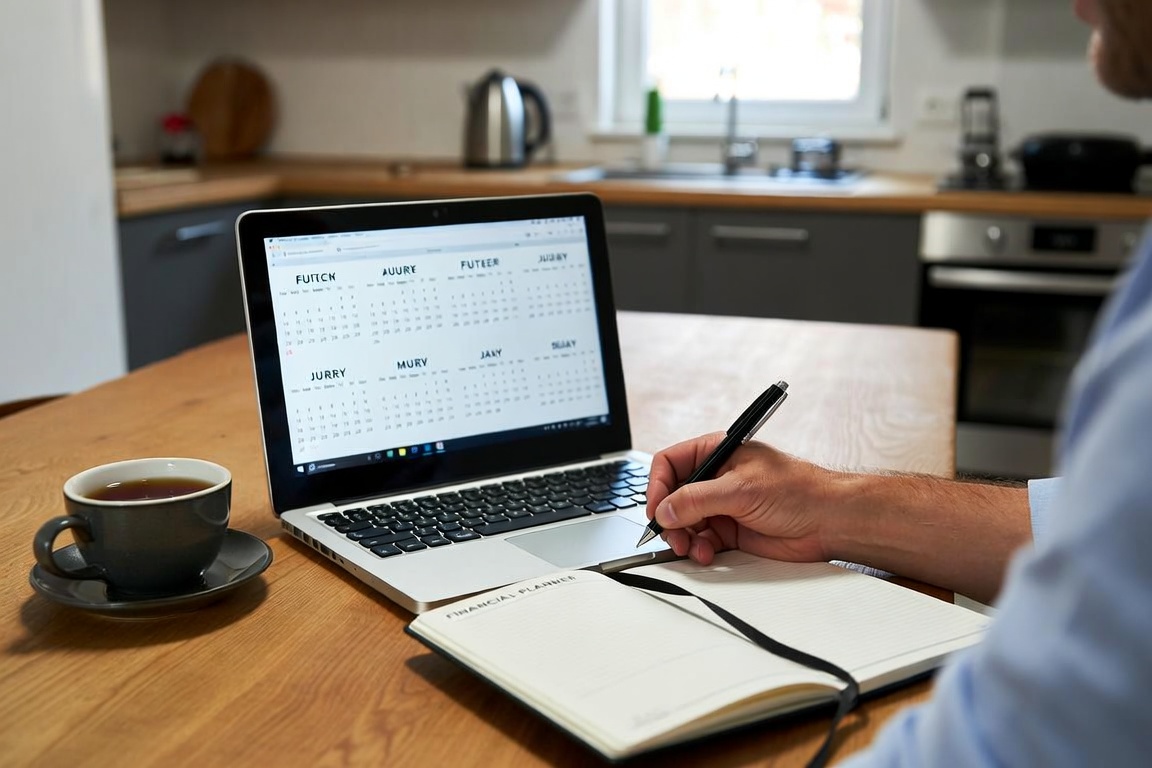
Energy bills follow seasonal patterns. Holiday spending concentrates in November and December. School supply costs spike in August. Summer travel clusters in June through August. Mapping these seasonal patterns on a 12-month calendar reveals the months where cash flow pressure is highest and allows you to prepare accordingly — either by accumulating more that month’s sinking fund in advance or by timing large purchases to fall outside the already-pressured months.
Making It Automatic
The most reliable way to execute the sinking fund approach is automation. Set up an automatic transfer from your checking account to your irregular expense savings account on the day after your paycheck clears. The money moves before you have the opportunity to spend it on something else. Over time, this automated preparation transforms the experience of irregular bills from financial stress to routine administration.
Disclosure: This site may receive compensation when you click on links or complete offers through our partners. Content is for informational purposes only and does not constitute financial advice.